Quotation marks play a crucial role in academic writing. They indicate words, phrases, or sentences have been taken directly from another source. However, incorrect or inconsistent use of quotation marks can lead to confusion, poor readability, and even accusations of plagiarism.
Understanding when and how to use quotation marks is essential for maintaining academic integrity and clarity. This blog explains the rules, examples, and common mistakes related to quotation marks in research papers, essays, and thesis.
Why Quotation Marks Matter in Academic Writing?
Quotation marks are not just punctuation marks; they represent precision in scholarship. They serve three main purposes:
- Acknowledging source material – showing that the words belong to someone else.
- Maintaining accuracy– ensuring the exact meaning of the source.
- Improving readability -distinguishing the writer’s ideas from the cited author’s words.
Incorrect use of quotation may misrepresent the original author’s intent or suggest that borrowed text is original, both of which undermine academic credibility.
Types of Quotation Marks
There are two primary types of quotation marks used in academic writing:
- Double quotation marks (“ ”) – Common in American English.
Example: The author argues that “climate change is the defining issue of the twenty-first century.” - Single quotation marks (‘ ’) – More common in British English, except for quotations within quotations.
Example: The researcher described the findings as ‘a turning point in marine biology’.
Always check the journal style (APA, MLA, Chicago, Harvard, etc.) to determine which format to use consistently.
When to Use Quotation Marks
Quotation marks should be used only when necessary– that is, when quoting exact words. Overuse can make writing appear disjointed or overly dependent on sources. Below are the key instances when quotation marks are appropriate.
3.1. Direct Quotations
Use quotation marks for exact wording from a source.
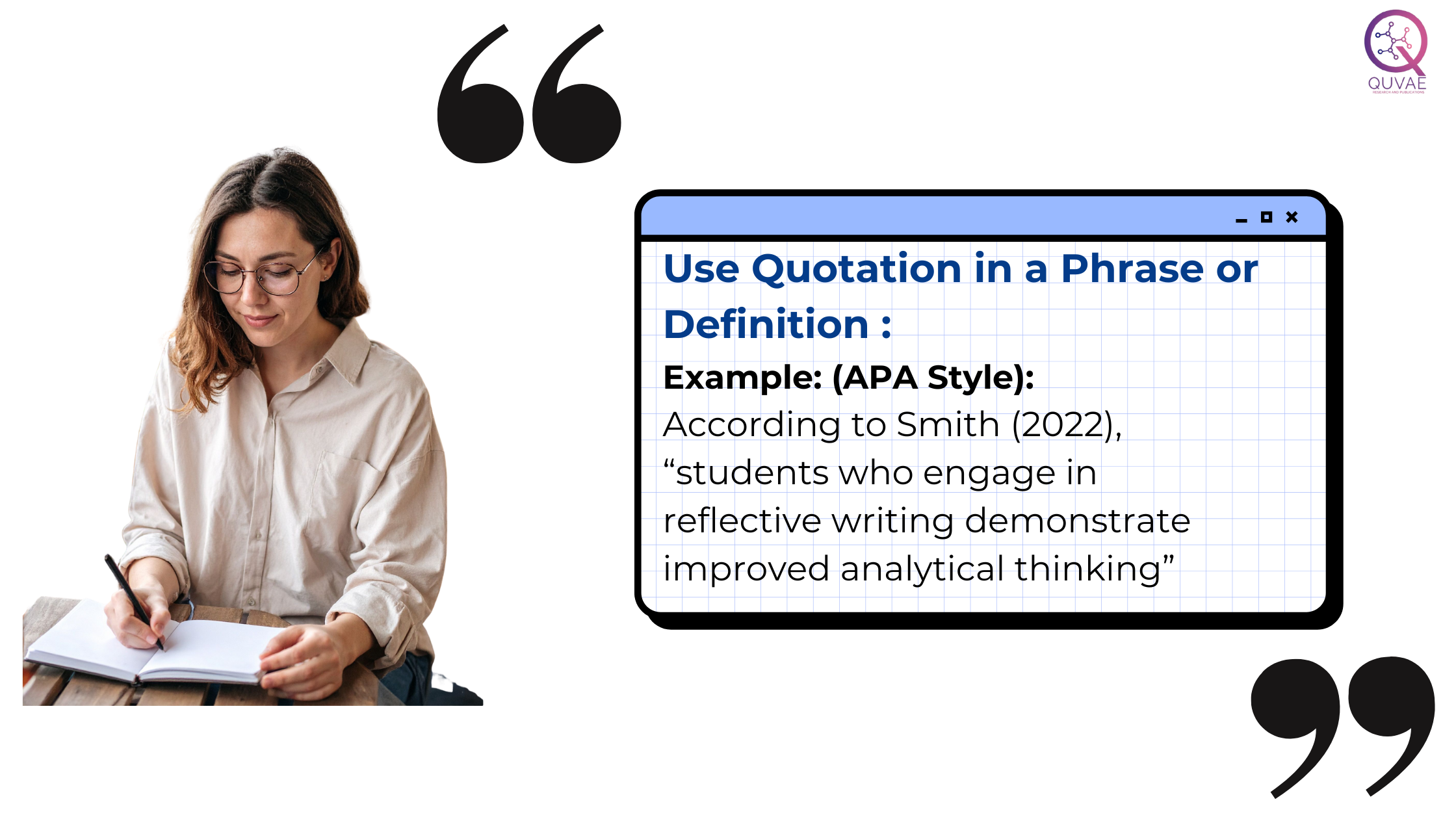
Example:(APA Style):
According to Smith (2022), “students who engage in reflective writing demonstrate improved analytical thinking”
If the quote is longer than 40 words (APA) or four lines (MLA), format it as a block quotation (indented and without quotation marks).
3.2. Quoting a Phrase or Definition
Short phrases, technical terms, or definitions may be placed in quotation marks when taken directly.
Example:
The World Health Organization (2023) defines “mental health” as a state of well-being in which individuals realise their abilities and cope with life’s stresses.
3.3. Quoting within a Quotation
When quoting material that already includes a quote, use single quotation marks inside double quotation marks.
Example:
As Johnson (2021) stated, “The teacher said, ‘Critical thinking is the foundation of education,’ emphasizing its importance in the curriculum.”
3.4. Titles of Short Works
Use quotation marks for titles of:
- Journal articles
- Book chapters
- Short stories, poems, or essays
Example:
In her essay “The Ethics of Genetic Modification,” Carter (2019) explores the moral dimensions of biotechnology. (Books, journals,) are mentioned in italics instead of enclosed in quotation marks.
3.5. Scare Quotes (Cautionary Use)
Scare quotes signal that a term is used in reservation.
Example:
Some politicians refer to the policy as a “reform,” though its practical impact remains unclear.
Use scares quotes sparingly in academic writing, as overuse may appear dismissive or unprofessional.
- Formatting and Punctuation Rules
Correct punctuation around quotation marks varies depending on the language style (American or British). Below are key rules applicable to most academic writing contexts.
4.1. Placement of Question Marks and Exclamation Points
These punctuation marks go inside the quotation if they belong to the quoted text, and outside if they apply to the entire sentence.
Example:
- Inside: The researcher asked, “What motivates students to learn?”
- Outside: What did she mean by “unprecedented growth”?
- Paraphrasing vs. Quoting: When to Choose
Excessive use of direct quotations can weaken academic writing by limiting the author’s analytical voice. In general:
- Use direct quotations for definitions, distinctive phrasing, or authoritative statements.
- Use paraphrasing when the idea matters more than the specific wording.
Example:
Smith (2022) noted that reflective writing activities enhance students’ ability to think critically.
This maintains the author’s voice by acknowledging the source.
- Common Mistakes in Using Quotation Marks
Even experienced researchers make errors in punctuation and attribution. Below are frequent mistakes and how to correct them.
6.1. Altering the Original Meaning
❌ Incorrect: “The results were insignificant” (originally said “statistically significant”).
Changing key words misrepresents the author’s meaning and constitutes academic dishonesty.
✅ Correct: Retain the author’s original wording or clearly indicate omissions or modifications using brackets and ellipses.
6.2. Overusing Direct Quotations
Embedding too many quotations creates a patchwork of sources rather than a coherent argument. Integrate quotations selectively and explain their relevance.
Better approach: Introduce, integrate, and interpret each quote within your own analysis
Examples from Academic Contexts
Example 1 – Research Paper
The authors concluded that “the introduction of AI tools has transformed clinical decision-making processes” (Nguyen et al., 2024, p. 56).
Example 2 – Literature Review
Brown (2021) argued that “renewable energy policies must balance economic growth and environmental sustainability” (p. 89).
Example 3 – Critical Discussion
While the study claims that “technology reduces inequality,” subsequent research suggests otherwise (Lee, 2023, p. 43).