Introduction
In academic publishing, the abstract is often the most important paragraph. It acts as the gateway to your research article, and it is the important section that editors, reviewers, and readers examine before deciding whether to continue reading. A strong abstract increases the likelihood of your work being noticed, read, cited, and even accepted for publication. Many researchers face more difficulty explaining their entire study into just 150 to 300 words. This guide explains, step by step, how to write a clear and effective abstract that communicates your study’s purpose, methods, key findings, and significance with precision and impact.
What Is an Abstract?
An abstract is a brief, self-contained summary of your research article. It helps readers quickly understand what the study is about, why the research was conducted, how the study was carried out, what the major findings were, and what the study ultimately concludes or contributes. A good abstract should be concise, and free from unnecessary explanations. It should be able to stand alone and make sense even if someone does not read the full paper.
Purpose of a High-Quality Abstract
A well-crafted abstract serves several important functions. It helps attract journal editors during the initial screening stage, gives reviewers a clear overview of your study, and increases your research visibility on indexing platforms such as Google Scholar, Scopus, and PubMed. A strong abstract also improves searchability when appropriate keywords are included and communicates your research in a way that both specialists and non-specialists can understand.
Types of Abstracts
Journals typically require either a structured or an unstructured abstract.
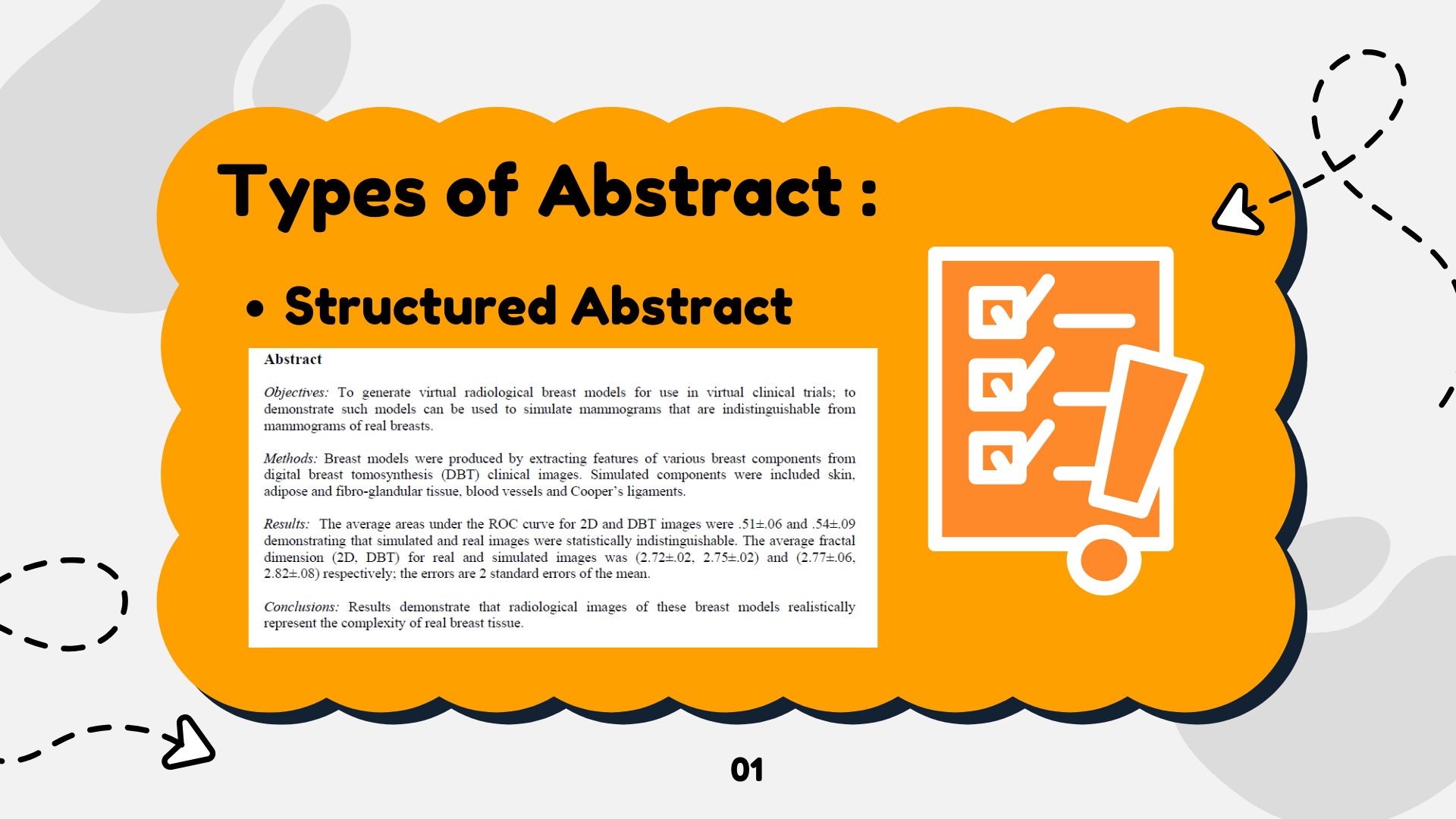
A structured abstract includes clearly labeled sections such as Background, Objective, Methods, Results, and Conclusion, and is commonly used in medicine, health sciences, and systematic reviews.
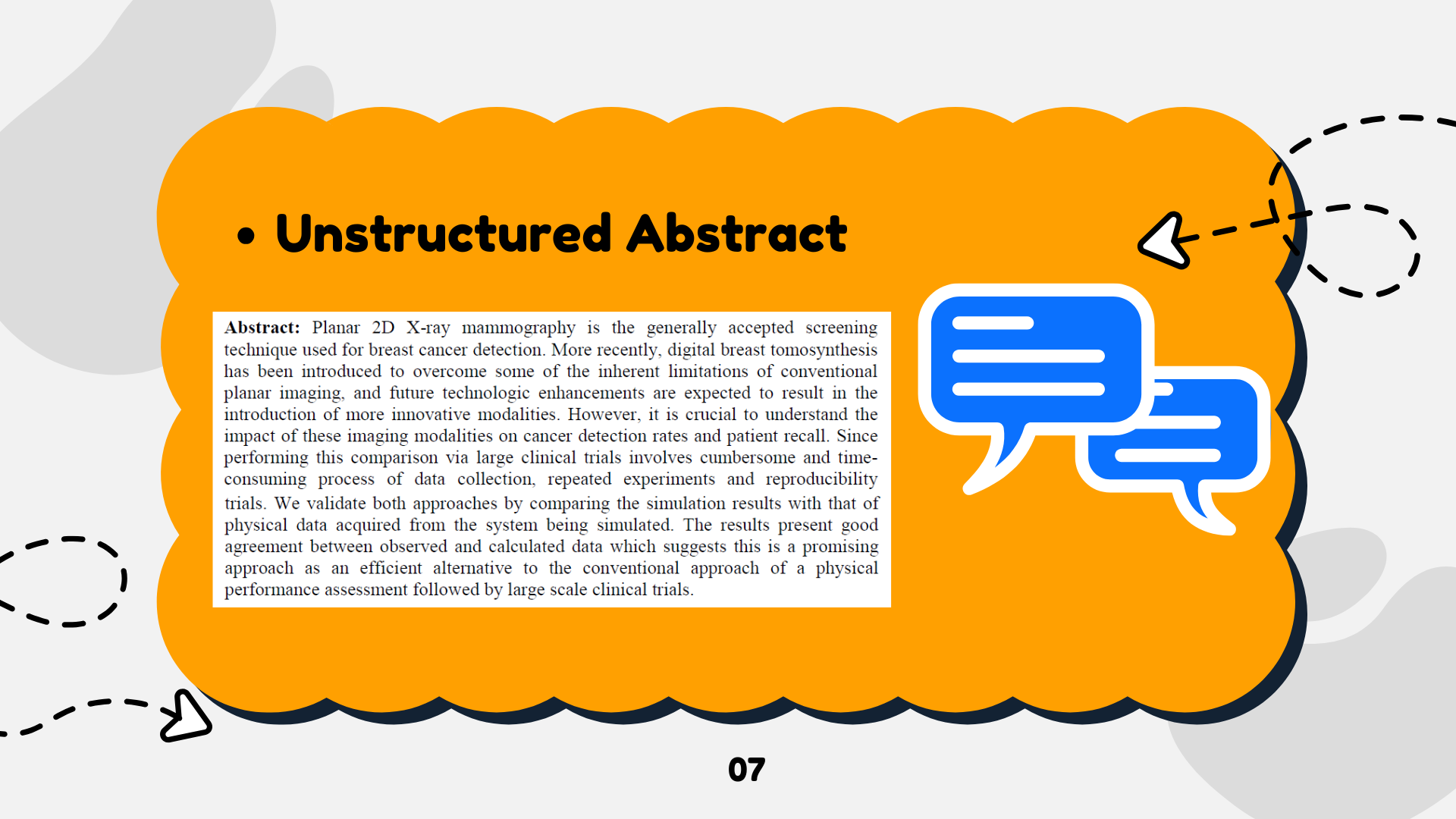
An unstructured abstract, on the other hand, is written in one flowing paragraph without headings and is widely used in engineering, social sciences, humanities, and natural sciences. It is essential to check the journal’s author guidelines to determine which format is expected before you begin writing.
Descriptive Abstract
A descriptive abstract gives a very brief overview of what the paper covers but does not include results or conclusions. It usually contains only the purpose, scope, and methods.It is short with 50–100 words.
Informative Abstract
An informative abstract provides a complete summary of the research.It includes the purpose, methods, major findings, and conclusions. Most research journals use this type.
How Long Does an Abstract Need to Be?
Most journals recommend keeping unstructured abstracts between 150 and 250 words, while structured abstracts often range from 250 to 350 words. It is crucial to follow the specific length requirements provided by the target journal.
What Not to Include in an Abstract
To maintain clarity and professionalism, several elements should be avoided in an abstract. These include detailed literature review content, definitions or theoretical explanations, citations or references, long descriptions of methods, tables, figures, abbreviations, unsupported claims, and overly emotional or promotional language. A high-quality abstract remains, simple, and transparent.
Tips to Improve the Quality of Your Abstract
One effective way to improve your abstract is to write it after you finish the full manuscript. It ensures accuracy and consistency. It is also important to use clear and straightforward language, avoiding complex grammar and unnecessary jargon. Maintaining proper tense consistency is essential: background and objectives are written in the present tense, methods and results in the past tense, and conclusions in the present tense. Keywords should be chosen carefully to improve discoverability, and your writing must be original and free from plagiarism or excessive AI overlap. Reading abstracts from high-impact journals can help you understand how experienced researchers summarize complex work concisely.
Common Mistakes to Avoid
Researchers commonly make mistakes such as offering too much background information, adding irrelevant details, using overly general statements, failing to report meaningful results, exceeding the word limit, repeating sentences from the introduction, or writing the abstract before completing the paper. Another frequent issue is treating the abstract like a research proposal instead of a summary of completed work.
Sample High-Quality Abstract
Microplastic pollution is an increasing global concern, yet its presence in drinking water remains insufficiently explored. This study aims to quantify microplastic particles found in municipal drinking water sources. Water samples collected from twenty urban locations were analyzed using Fourier-transform infrared spectroscopy. Microplastics were detected in eighty-five percent of the samples, with concentrations ranging from twelve to sixty-eight particles per liter. The dominant types identified were polyethylene and polypropylene. The findings indicate widespread microplastic contamination in urban drinking water and highlight the need for improved filtration and monitoring practices.