
For researchers, choosing the right journal is one of the most important steps in the publication journey. Two of the most trusted and widely recognised indexing databases in academic publishing are Scopus and Web of Science (WoS). Although both are considered high-quality and reputable, they differ in scope, coverage, evaluation criteria, and usefulness for researchers.
This blog explains the key differences between Scopus and Web of Science journals to help you make an informed decision.
Scopus is a large abstract and citation database owned by Elsevier. It covers a broad range of disciplines including science, engineering, medicine, social sciences, arts, and humanities.
Scopus is popular among early-career researchers because of its wide journal coverage and relatively faster indexing process compared to Web of Science.
Web of Science (WoS) is maintained by Clarivate Analytics and is known for its strict journal selection standards. Journals indexed in WoS are often considered more selective and prestigious.
Web of Science is especially valued for its Impact Factor (IF), which is widely used in academic evaluations, promotions, and funding decisions.
Key Differences Between Scopus and Web of Science Journals
- Journal Coverage
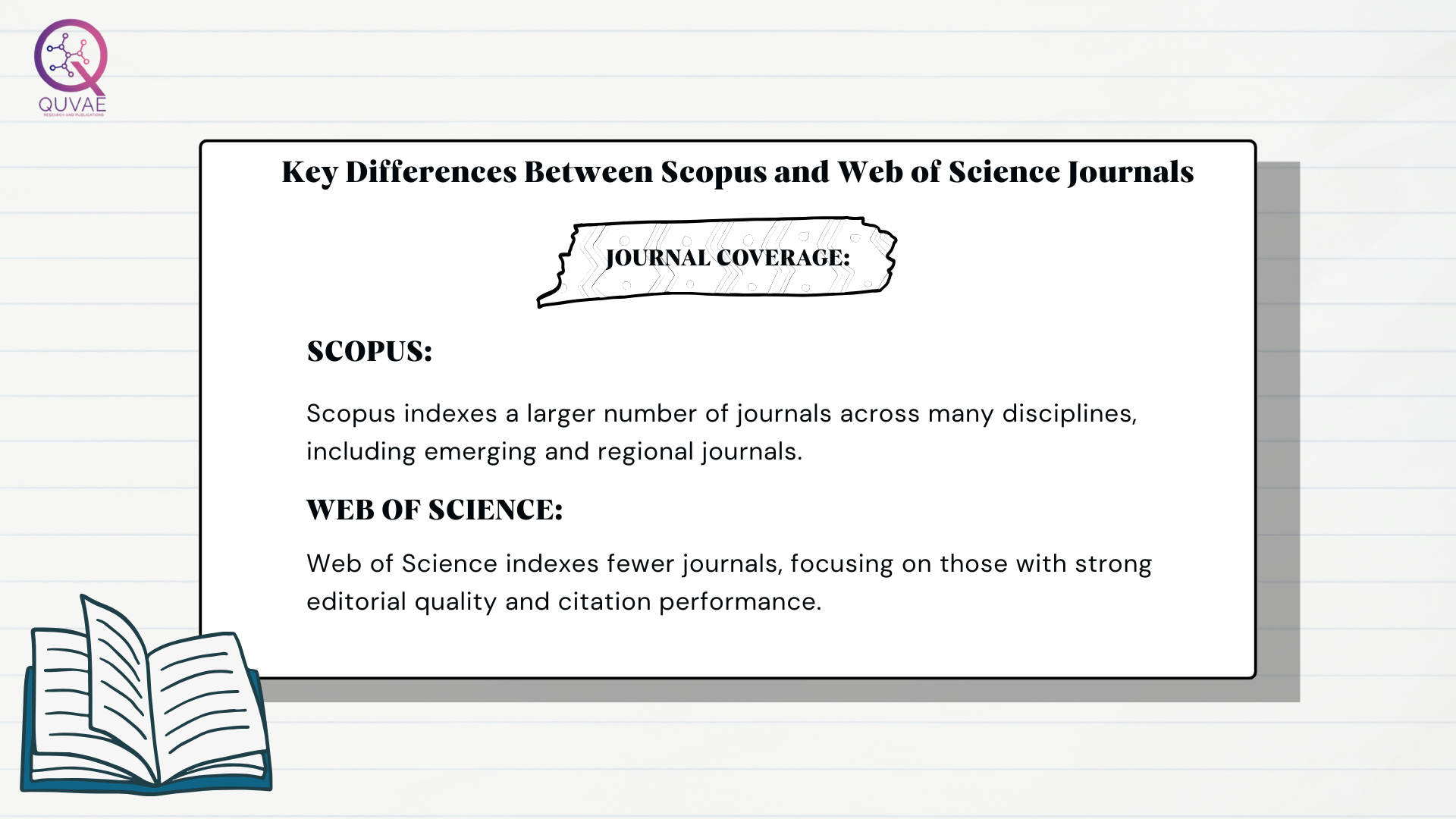
Scopus indexes a larger number of journals across many disciplines, including emerging and regional journals.
Web of Science indexes fewer journals, focusing on those with strong editorial quality and citation performance.
Scopus=Broadercoverage
WoS = selective coverage
- Indexing Categories
Scopus classifies journals into Q1, Q2, Q3, and Q4 quartiles based on CiteScore metrics.
Web of Science categorizes journals under SCIE, SSCI, AHCI, and ESCI, with Impact Factor available mainly for SCIE and SSCI journals.
- Impact Metrics
Scopus uses:
- CiteScore
- SCImago Journal Rank (SJR)
- Source Normalized Impact per Paper (SNIP)
Web of Science uses:
- Journal Impact Factor (JIF)
- Journal Citation Indicator (JCI)
Impact Factor is exclusive to Web of Science, making it more influential in institutional evaluations.
- Acceptance and Review Standards
Scopus journals generally have flexible acceptance ranges, though quality standards still apply.
Web of Science journals follow very strict peer-review and ethical standards, often leading to higher rejection rates.
- Publication Speed
Scopus journals usually offer faster review and publication timelines.
Web of Science journals may take longer due to rigorous review processes.
- Use in Academic Evaluation
In many universities:
Scopus publications are preferred for PhD requirements and early career promotions
Web of Science publications are often required for faculty promotions, grants, and rankings
This varies by institution and country, so always check official guidelines.
- Risk of Predatory Journals
While both databases monitor quality:
Scopus has a higher risk of discontinued journals, so authors must verify current indexing status.
Web of Science has lower risk due to stricter selection and continuous evaluation.